
|
Big George interviews George MacDonald Fraser on Tuesday 19/10/99
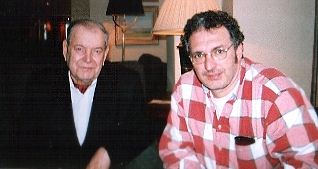 The interview was scheduled to begin at 11.30 am The trouble was, the train I'd caught in good time, arrived 100 yards outside of Euston Station at 10.57 am - but it didn't pull in until quarter past. No time to call the PR girl on her mobile (which was switched off anyway), just straight down to the tube station to wait three minutes for the connecting train to arrive (three northern line minutes equals seven earth minutes). Then change at Tottenham Court Road for the Central Line (along which most of the BBC's principle London buildings are situated) and out at Lancaster Gate to get a cab for the short jaunt to the Harrington Hall Hotel, situated just off Gloucester Place.
"Nah mate, the 'arrington 'all 'otel is orf Gloucester Road" the cabbie informed me, which is on the other side of Hyde Park! So, I was already late and in a different borough from the Hotel. But, by the grace of God, blind panic and a nifty cabbie I was only 15 minutes late for my meeting with George MacDonald Fraser We'd met the day before at Hatchards where he was signing copies of the latest packet of the Flashman Papers: Flashman and the Tiger, in Hardback - published by Harper Collins, price £16.99, or ten bob from an Internet site; based in Paraguay (to whom you entrust your credit card details and a true belief in Atlantic postage) Now in case you're unaware of the Flashman papers or just who Sir Harry Paget Flashman VC is - he first came to the public gaze 150 years ago in Tom Browns School Days, as a most fearful bully. He roasted the aforementioned little wimp and was expelled for being drunk. Then 30 years ago George MacDonald Fraser wrote the first of the series, maintaining to this day he merely edits the papers, which were discovered in a Leicestershire tea-chest in 1966. All the characters, events and places in the book are real and accurate, down to the smallest detail and the rest, as they say, is history - the most alive history of the 19th century ever written, through the eyes of the biggest whoring blaggard and spineless flatulent coward of all time, my mate Flash Harry I started reading Flashman in 1981 when I was bought a copy of Royal Flash by the leader of the band I was working with at the time, Larry Wallis; the bands name I seem to recall was: The Pork Torpedoes of Love. We had the dubious pleasure of recording the only Stiff Record album catalogued but never released, it's there for all to see in Pete Frames Rock Family Trees. Anyway, Royal Flash is the second book in the series and the only one of the 11 books, to date, that has been made into a movie. I'd seen the film, which only confirmed a book is always far superior to its film adaptation. But I took it no further, until 4 years ago, when I had a heart attack; which nearly did for me. Whilst lying on the slab I realised with great joy that I had plenty of time to do some reading. The film Royal Flash had been on the box a week or so before my little problem occurred, and I remembered what a bloody good read it was. So I decided to read the first in the series, and within a page I was hooked. I read all ten (Flashman and the Tiger is the 11th) back to back in record time and then went straight back and read them all again. The only other book I read during that time was George MacDonald Fraser's autobiography: Quartered Safe out Here. You won't read a better book about the WW2 Burma campaign than that. It has an unabridged cassette version read by the author himself, which I highly recommend you borrow from your local library the next time you're going to be on the road for 18 hours But the day I met him I only had 15 minutes, a MINIDISC () recorder and a lump in my throat at the thought of interviewing, in my humble opinion, the greatest living author on the planet I started off by asking him: Big G: Why are you still writing Flashman - is it for the money, is it because there are still more papers to discover, or is it an obligation to the reader? G.M.F: It's good fun. I suppose it's an obligation to the reader, it pays well, but chiefly because I like doing it. It's great fun researching it, it's great fun writing it Big G: How much research goes into each book? G.M.F: Oh quite a bit, I got the idea for the last one fifteen years ago, when I was on holiday in Bad Ishl in Austria and saw what a salt mine was like. I thought I'll have to use that one of these days. From there I just turned it over in my mind and then and about 18 months ago, I got down to it seriously. I suppose the research then took me another couple of months. The other two parts of the book; because its got three stories in it; with one of them the research was very easy because it consists of the transcript of one court case: the Baccarat Case (1) ; so that was a snip. The Zulu war one I had written 25 years ago (2) and all I had to do was revise it a bit. Big G: When did Flashman first take your fancy? G.M.F: I'm not sure. He's been in my mind, I suppose ever since I read the book when I was... twelve years old I should think. When, in the 1960's I decided that I wanted to write a Victorian adventure story, he was the character who just came to mind. I mean, there he is, expelled from Rugby just about the time Queen Victoria comes to the throne and the whole Imperial thing starts Big G: Did you think about the chronology when you first started writing Flashman? G.M.F: No Big G: So how difficult has that been to bounce around? G.M.F: Not terribly, in the American edition of the first book the publisher asked me to write a who's who entry, I did it in about five minutes and I've been stuck with it ever since. At the time I thought 'Where's he going to go?' He's going to go to Madagascar, he's going to go to Borneo, he's going to fight in the American Civil War - whose side? Why not both sides! So I got stuck with that Big G: Have any of the relatives of some of the characters ever confronted you at all? G.M.F: Yes, one or two. People who are the great grandsons of people who occurred in the books. For instance a man who I met and got friendly with just a year or two ago. General Rose, who was the man in Yugoslavia originally, he is the grandson of Hugh Rose (3) who was Flashman's commanding officer in Flashman and the Great Game. You know, that sort of person but I haven't had any complaints so far Big G: Of all the books, which would you say is your favourite? G.M.F: Of the Flashman books? I've no idea really. Somebody said that Flashman at the Charge is the best constructed novel, I don't know about that. Kingsley Amis said that it's got to be Flashman and the Redskins, that was his choice. I don't really have one. Any one except the last one, because by the time I've finished whichever one it is I'm fed up Big G: What about your favourite spot he's gotten himself into? G.M.F: People ask for a typical example of his behaviour and I think the one that appeals to me most is in: Flashman at the Charge. He's being pursued through the snow in a sledge by Cossacks and he flings his mistress out into the snow to lighten the sledge (laughs). I like that Big G: I've read them many times and he still doesn't fail to shock me. G.M.F: Good Big G: There's a great debate about Flashman going onto screen, did you have any choice about Malcolm McDowell's casting in the film Royal Flash? G.M.F: No I didn't. I wrote the screenplay but the package was Malcolm to play Flashman and Alan Bates to play his rival, Rudi Von Starnberg. I thought it would be a good idea to swap them over because Bates is big and burley and so on. Malcolm is sprightly and bright and that sort of thing, but as it came out it wasn't half bad. I suppose I must take part of the blame, it didn't do all that well but I've conceived an affection for it over the years. There were some people who did extremely well in it. It's an odd thing, it's a movie which has an awful lot of people in tiny parts who have since become famous. There's a station master; I don't think he's even got a line; played by David Jason (4). There's a lovely little cameo, he's only on screen for about 45 seconds: Bob Hoskins as the Police Sergeant and he's perfect; straight out of the book Big G: Talking about perfect, what about Oliver Reed? G.M.F: That's right, Ollie was Bismarck and Henry Cooper was John Gully MP. Also Alistar Sim, Joss Ackland, Lionel Jeffries and Britt Ekland, who was a very good heroine Big G: Was it difficult to abridge the story to make it into a movie? G.M.F: Yes, because there's a lot of it. Any movie that is made of one of your books, you would like to see it about eleven hours long, but of course it can't be Big G: Palace Pictures were looking into making Flashman into a series like Sharpe. Was you involved in their negotiations? G.M.F: Yes I was. In fact I was very nearly off to Afghanistan with the Palace people to have a look at locations and so on. But the deal fell through and hasn't been revived. To be frank I don't know that I'm terribly sorry. For one thing there isn't a Flashman around that I know of. Errol Flynn's dead, alas. So is the other man who wanted to play him: David Niven. He said to me "if only I'd been born forty years later" Big G: There's been great debate across the web sites of the world to see who could play Flashman G.M.F: Well, Burt Reynolds was suggested - but that company wanted to Americanise it. The original Flashman casting for the movie that didn't get made was John Alderton from the TV series Please Sir. Another suggestion was made to me by the American director Dick Fleicsher (5), with whom I've worked. It sounds bizarre, but when you think about it, it's not so bad: John Cleese. He was one of the favourites Big G: I think he's a bit long in the tooth nowadays G.M.F: Well this was about twenty years ago Big G: How much of Flashman is George MacDonald Fraser? G.M.F: He thinks the way I do, that's it. He doesn't behave the way I do, or I don't behave the way he does Big G: Do you feel there was a similarity with the way you felt about action during your time in the Burma campaign and Flashman? G.M.F: I suppose so, but there's a curious thing about Flashman. People write to me frequently and say "he's not a coward at all he's just a very modest man, in fact he's heroic". The answer to that is, very often he doesn't get any choice. Indeed when you're a soldier you don't get much choice. It would take an awful lot of courage to run screaming from the battlefield. I mean you're there, and you do what you have to do and that's that. I don't think Flashman is particularly heroic but sometimes yes, he fights like a cornered rat, and he's big and he's strong and he's vicious; so he's quite successful at it! Big G: How long after the event did you write your autobiography? G.M.F: Oh nearly fifty years. I think I wrote "Quartered Safe out Here" in 1994 (6) . It was going to be the first book I ever wrote. Thank God it wasn't, because it would have been just another war memoir if I'd done it in the fifties, assuming it had got published. But fifty years later, looking back, things have changed so much that it adds a dimension to the book that it just wouldn't have had Big G: Have you ever thought of doing Part Two? G.M.F: Part two isn't all that interesting. That would be my time in India and the Middle East. Much less dramatic than Burma, although I was in Palestine at the time Israel was coming into being and that was a pretty dicey time. But I've covered that in a way in my short stories. The McAuslan stories; being in command of the night train from Cairo to Jerusalem, that kind of thing. So really I don't think there's an immediate sequel to Quartered Safe out Here Big G: I was thinking more about your exploits in the Print and Media business G.M.F: I see what you mean, possibly. I am going to do something autobiographical, partly newspapers and part of the film business, which has been fascinating Big G: You've already done The Hollywood History of the World G.M.F: That's right and I've done seven or eight movies, some of them big budget jobs. I've worked in Hollywood and that's always interesting. If there's one thing people are interested in, it's movies Big G: Can you tell me a little about working on the James Bond film: Octopussy (7) G.M.F: That was great fun and not like any other motion picture. In the first place you know it's going to get made. They're very serious people and there's no question of them having to go and hunt for money or anything like that. They get the red carpet rolled out for them at MGM. Cubby Broccoli had the major office in the MGM building. What happens there is different. Usually you talk to a producer, a director and kick about the ideas for the film. Mostly I've adapted books and they've said to me "off you go and adapt the book" and I've done it and that's been that. But on a Bond picture it's different. That plot has got to be settled before you start writing. So you have a big conference which involves all sorts of people; Cubby Broccoli and his aids, his producers, the director, Roger Moore once or twice, art director, production designer, the whole damn lot, even the publicity man; and ideas were just kicked about. Eventually we hit on a plot and I went away and wrote it. And then rewrote it. And then rewrote it, again and again..... Big G: Were you working on set as well? G.M.F: No, not on that one. The farther you can stay away from the actual shooting of a film the better, because if you're there they'll just make you work. Every time I've gone near the shooting of a film I've finished up working. The last time was in tragic circumstances. Roy Kinnear got killed halfway through the last Musketeer picture (8) . So I had to fly to Spain and rework the scenes of his that were still to be shot, so that it could be done with either a double or with someone else appearing. That was a rotten job. He was a great loss and it depressed the whole production Big G: Did you know he starred in a 1966 TV sitcom called "Inside George Webley"? G.M.F: I didn't know that. He was a great wee fellow was Roy. But as I say it wrecked any chance the picture had of success. Not only because of having to re-jig it and that sort of thing, but it just cast a gloom over the whole proceedings Big G: Going back to Flashman, how do you think he saw the turn of the 19th Century? G.M.F: I'd have to go and look to see where he was. The Boxer rising was in 1900 (9 ) but I'm not sure when it started, I'd have to look at that. But I have a nice card at home, an illustration of the celebrations at the Savoy at midnight on 31st of December 1899 and it looks as though he'd fit in there. But I just don't know, he could well have spent it anywhere, on a boat or in jail, you name it Big G: George MacDonald Fraser thank you G.M.F: Well thank you George Then I turned off the recorder and we talked briefly about the finer points of heart surgery, before I bid him farewell. He was off to a big newsprint mogul type nosh up with the likes of Max Hastings. I, on the other hand, caught the 13.24 from Euston, and started reading: Flashman and the Tiger - which had me guffawing so much I couldn't have cared less how late the train arrived back FOOTNOTES (with grateful acknowledgments to David Tibbetts) 1. The Tranby Croft Scandal of 1890 in which Edward, Prince of Wales, was caught up in a alleged case of cheating at baccarat. The accusation eventually went to trial in 1891 and Gordon-Cummings, who was accused of cheating, lost 2. An abridged version of Flashman and the Tiger was published in the Daily Express in 1975 3. Hugh Rose commanded the army that stormed Jhansi during April 1858. It was Rose's idea to sneak Flashman into Jhansi beforehand to persuade Lakshmibai, Rani of Jhansi, to give herself up. Flashman was with General Rose a total of five days and probably thought that was five days too many! 4. David Jason, one of the United Kingdoms most enduring TV comic actors (star of classics such as: Only Fools and Horses, Open all Hours, Inspector Frost, Darling Buds of May), actually played the Mayor of Strackenz, not a station master and did in fact have a speaking part: "And on this historic day, we humbly (nods in deference to Flashman, who at this point in the film was posing as Prince Carl; the day before his wedding) invite your Royal Highness to inaugurate Strackenz's first public locomotive steam railroad train and carriages. (proud pause for crowd approval, that didn't come) Travelling at speeds in excess of 10 miles every hours. Your Highness". He then hands Flashman a bottle of Bubbly with which to christen the train, which he launches with gusto hitting an attendant on the head, knocking him out cold 5. Dick Fleischer, son of animator Max Fleischer, was born in 1916. George MacDonald Fraser scripted his 1985 film, Red Sonja. Other notable Fleischer films include Conan the Destroyer, 10 Rillington Place, Fantastic Voyage, 20,000 Leagues Under The Sea, The Vikings and Soylent Green 6. Quartered Safe out Here was published in 1992 7. Octopussy was released in 1983 and was Roger Moore's penultimate Bond film. It was Maud Adams's, who played Octopussy, second Bond film. She had played Andrea Anders, who was Scaramanga's (Christopher Lee) lover, in The Man With The Golden Gun in 1974 8. The Return of the Musketeers was released in 1989 9. All we know for certain is, that Flashman took part in The Siege of the Foreign Legation in Pekin, which was during the summer of 1900 |